
You glance at the price of a private training session and then look at a group class, and the gap feels hard to justify. That confusion is completely normal. Understanding why private training costs more than group options comes down to a few real, concrete factors: how a trainer’s time is used, what you actually receive during the session, and what it costs to deliver that service. Once you see the full picture, the price stops feeling arbitrary and starts making a lot of sense.
Table of Contents
Key takeaways
| Point | Details |
|---|---|
| Trainer time drives cost | Private sessions use 100% of a trainer’s hourly capacity for one client, making individual cost higher. |
| Group training splits the bill | Multiple participants share trainer time, which lowers each person’s cost but reduces individual attention. |
| Personalization has real value | Private training includes custom programming and real-time corrections that group formats cannot match. |
| Semi-private is a smart middle ground | Small group sessions of 3 to 5 people balance personalized attention with more affordable pricing. |
| Your goals should guide your choice | Budget matters, but matching the training format to your specific fitness goals matters more. |
Private vs. group training: what you’re actually comparing
Before you can understand the price difference, you need a clear picture of what each format actually delivers. They are not just the same workout with a different number of people in the room.
Private training is a one-on-one session between you and a coach. Every minute of that hour belongs to you. The trainer watches your movement, adjusts your form in real time, and builds a program specifically around your body, your history, and your goals. Nothing is generic.
Group training is a shared session where one trainer leads multiple participants through a workout. The energy is often high, the cost per person is lower, and the structure works well for general fitness. The tradeoff is that the coach’s attention is divided.
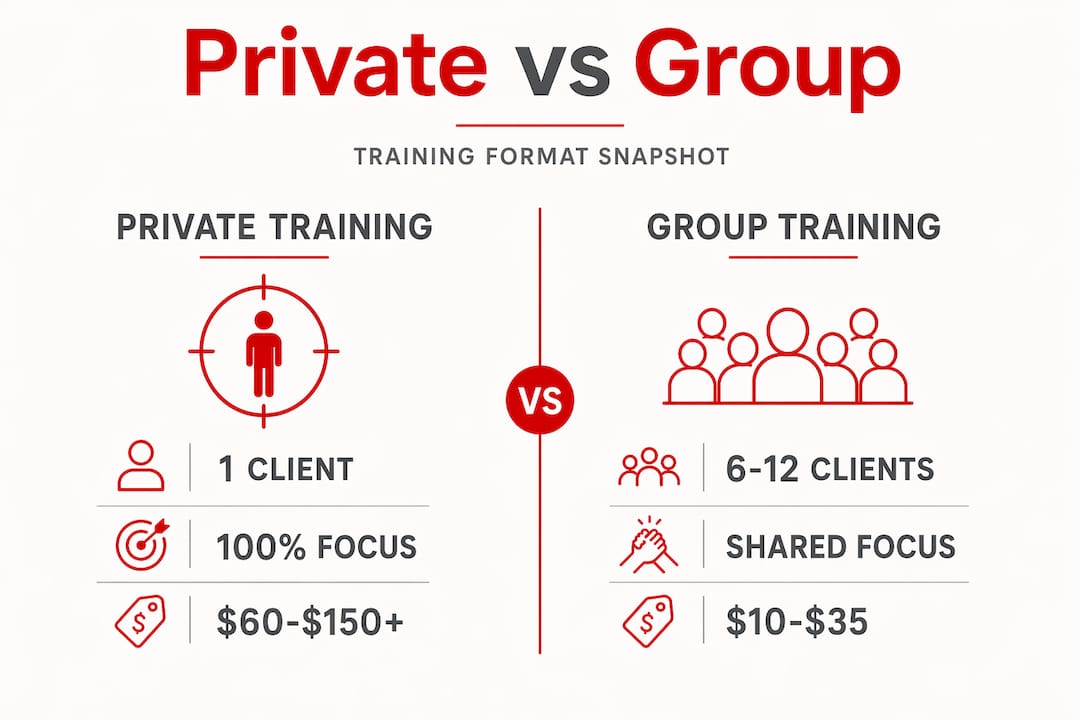
Here is a general look at how pricing typically breaks down across formats in the U.S.:
| Training format | Typical price per session | Participants |
|---|---|---|
| Private (1-on-1) | $60 to $150+ | 1 |
| Semi-private | $40 to $60 | 2 to 5 |
| Group class | $10 to $30 | 6 to 20+ |
Location plays a real role in these numbers. Urban markets like California and New Jersey push private session rates toward the higher end, while smaller markets tend to sit closer to the floor. Facility type matters too. A boutique studio with premium equipment charges more than a community recreation center.
The semi-private format sits between the two extremes and deserves its own conversation, which we will get to shortly.
Why private training costs more: the economics of trainer time
This is the core of the whole conversation. When you book a private session, a trainer’s full hour is locked in for you and only you. They cannot train anyone else during that time. That means the entire cost of that hour, including their time, expertise, and any facility fees, falls on one person.
In a group class with ten participants, that same hour generates revenue from ten people simultaneously. The trainer earns more per hour overall while each individual pays far less. Group training spreads trainer time across multiple clients at once, and that shared cost structure is exactly why group classes are priced so much lower.

Overhead also shapes the number on your invoice. Big-box gyms retain a significant portion of session fees to cover equipment maintenance, facility space, and administrative costs. A trainer working at a commercial gym may only take home 40 to 60 percent of what you pay. Independent trainers keep more of their earnings but often carry their own insurance, equipment, and scheduling costs.
Here is a quick breakdown of what drives private session pricing:
-
100% of trainer’s hourly capacity dedicated to one client
-
Customized session preparation before you even walk in
-
Facility or studio rental fees (for independent trainers)
-
Continuing education and certification costs passed into rates
-
Liability insurance and professional overhead
Pro Tip: Ask any trainer you are considering whether they are employed by the gym or work independently. Independent trainers often have more flexibility on pricing and packages, especially for longer-term commitments.
What you actually pay for in private training
The cost of private training is not just about time. It is about the quality and specificity of what happens during that time. This is where the advantages of individual training become most visible.
When you work one-on-one with a coach, the session starts with you. Your movement patterns, your limitations, your history with injury, your specific goals. Personalized coaching addresses unique goals and limitations in a way that a group format structurally cannot. A trainer leading a class of fifteen people cannot stop the whole group to correct your hip alignment on a squat.
Here is what private training typically includes that group formats do not:
-
A movement assessment before programming begins
-
A program written specifically for your body and goals
-
Real-time form corrections during every set
-
Immediate adjustments if something is not working for you
-
Accountability that is personal, not general
Hands-on instruction and real-time adjustments also reduce injury risk significantly. In a group setting, a trainer may not catch a faulty movement pattern until it has already caused discomfort. In a private session, that correction happens immediately.
For parents considering training for their kids, this point matters even more. Youth athletes have developing bodies with specific needs. A coach who can watch every rep and adjust in real time is not a luxury for a growing athlete. It is genuinely protective.
The benefits of private training go beyond faster results. They include a safer, smarter path to those results, which saves you time, money, and pain in the long run.
Semi-private training: the smart middle ground
If the cost of private training feels out of reach right now, semi-private training deserves serious consideration. This format typically involves 3 to 5 participants per session, and it changes the math in your favor without completely sacrificing the attention you would get one-on-one.
Semi-private rates typically range from $40 to $60 per person, which puts them well below private session pricing while staying far above the generic group class experience. The trainer can still observe your form, make corrections, and build some degree of personalization into the session. You also get the motivational energy of training alongside other people.
Here is how the three formats compare on the factors that matter most:
| Factor | Private | Semi-private | Group class |
|---|---|---|---|
| Individual attention | High | Moderate | Low |
| Customized programming | Yes | Partial | No |
| Cost per session | $60 to $150+ | $40 to $60 | $10 to $30 |
| Motivation from peers | Low | Moderate | High |
| Best for specific goals | Yes | Sometimes | General fitness |
Semi-private works best for people who have some training experience, are comfortable with the basics of movement, and want to keep costs manageable without losing all coaching quality. It also works well for families or friends who want to train together with a real coach guiding the session.
Pro Tip: If you are new to training or working around an injury, start with at least a few private sessions before transitioning to semi-private. Getting the fundamentals right with full attention first makes every session after that more effective.
At Repphilosophy, the semi-private training options are designed with exactly this balance in mind, giving you real coaching without the full private price tag.
How to choose the right format for your goals and budget
Now that you understand the structure behind the pricing, the question becomes: which format is actually right for you? Here is how to think through it clearly.
-
You have a specific goal or limitation. If you are recovering from an injury, training for a competition, or working around a health condition, private training is worth the investment. The personalization is not optional in these cases.
-
You are brand new to fitness. Learning movement patterns correctly from the start protects you long-term. A few months of private training to build your foundation pays dividends for years.
-
You are budget-conscious but still want guidance. Semi-private or group training at a quality facility is a genuinely good option. You still benefit from professional coaching, just with less individual focus.
-
You are a parent evaluating options for your child. Youth athletes benefit enormously from individual attention during formative years. If budget allows, private or semi-private is worth prioritizing.
Before you commit to any program, ask these questions:
-
What certifications does the trainer hold?
-
How do they handle clients with injuries or limitations?
-
What does a typical session look like?
-
Is programming customized or the same for everyone?
-
What is the cancellation and rescheduling policy?
Pro Tip: Many trainers, including those at Repphilosophy, offer a free consultation or trial session. Use it. You will learn more in thirty minutes with a coach than in hours of reading about training options online.
The one-on-one tailored training available at Repphilosophy is built around exactly this kind of personalized approach, whether you are in 4S Ranch or training virtually.
My honest take on training costs and value
I have worked with enough clients to say this with confidence: the people who feel like they wasted money on training almost always chose the wrong format for where they were in their fitness journey. Not a bad trainer. Not a bad gym. The wrong format.
Someone brand new to movement who jumps into a group class because it is cheaper often spends months reinforcing bad habits. Then they come to private training later to fix those habits, and now they are paying twice. The “cheaper” option ended up costing more.
What I have also seen is the opposite. A client who has solid movement fundamentals and just needs structure and accountability can thrive in a semi-private or group setting. Paying for private training when you do not need that level of attention is not smart spending either.
My take on why choose private training comes down to one question: how specific are your needs? The more specific your goal, your limitation, or your starting point, the more private training pays for itself. When your needs are general, group training is a genuinely great value. The mistake is treating price as the only variable.
Invest in the format that matches where you are right now, not just the one that fits the budget. Your results, and your long-term relationship with fitness, depend on getting that match right.
— Coach
Ready to find your perfect fit at Repphilosophy?
At Repphilosophy, we believe every person deserves a training experience that actually fits their life, their goals, and their budget. That is why we offer everything from private coaching sessions to bring-a-buddy memberships, group classes, youth sports performance training, and virtual coaching options.

Whether you are a parent looking for safe, structured training for your young athlete, or an individual ready to invest in a bespoke plan that finally moves the needle, we have a path for you. You do not have to choose between quality and affordability. At Repphilosophy, both are on the table. Explore our virtual coaching memberships or come see us in 4S Ranch. Let’s set the wheels in motion together.
FAQ
Why does private training cost so much more than a group class?
Private training monopolizes 100% of a trainer’s hourly capacity for one client, so the full cost of that time falls on one person rather than being divided among many participants.
What are the main benefits of private training over group training?
The core benefits of private training include personalized programming, real-time form corrections, injury prevention, and a session structure built entirely around your specific goals and limitations.
Is semi-private training worth it compared to private sessions?
Semi-private training is a strong option for people who want more coaching attention than a group class provides but cannot justify the full cost of private training. Rates typically fall between $40 and $60 per session.
How does location affect the cost of private training?
Urban markets like California and New Jersey command significantly higher trainer rates than rural areas, so where you train can shift the price of a private session by $30 to $50 or more per hour.
When should I choose private training over group training?
Choose private training when you have a specific goal, are recovering from an injury, are new to structured exercise, or need a program tailored to a health condition. Group training works well for general fitness once you have solid movement fundamentals.